by Brian Miller
Scale: 1/20
As everyone knows, the Wright brothers operated a bicycle shop in
Dayton Ohio; this was lucrative enough to fund their interest in
aeronautics.
Their emphasis was on control of the aircraft. They developed the
idea of three axis maneuvering.
In 1896, they began their experimentation in earnest. They started
by testing Otto Lillienthals formulas for lift and drag, then moved
on to using a wind tunnel when they discovered these formulas were in
error. They developed and tested many wing configurations, devising
experimental tables relating to lift and drag.
Although mankind has had spectacularly poor track record emulating
the flight of creatures, one of their innovations was based on
observing birds. Wilbur theorized that control of the plane could be
effected, like a bird, by twisting the ends of the flight surfaces,
or warping the wings. This, combined with the idea of banking into
turns (inspired by their work with bicycles) allowed them to develop
a workable method for controlling a flying machine.
By 1900 the brothers had started going to Kill Devil Hill in Kitty
Hawk, North Carolina to perfomr large scale experiments. This
provided seclusion; the race for powered flight was becoming
competitive. Their visits were limmited to vacations; in the end,
they bascially developed flight on their spare time.
In 1900 and 1901, they were flying large scale gliders to test the
basic vehicle design. In 1902, they started flying their design as
an unpowered glider.
Finally, In December of 1903, Orville flew the first powered flight
120 feet. Three more flights were flown that doay, eventualy ending
when the Flyer was damaged on the last landing.
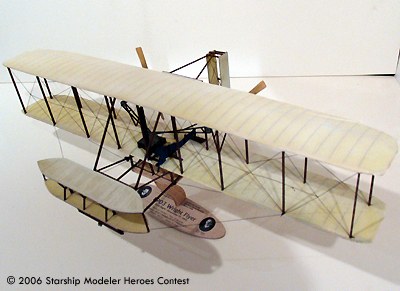
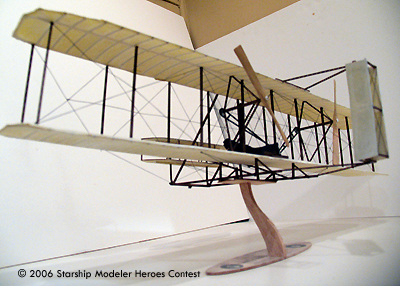
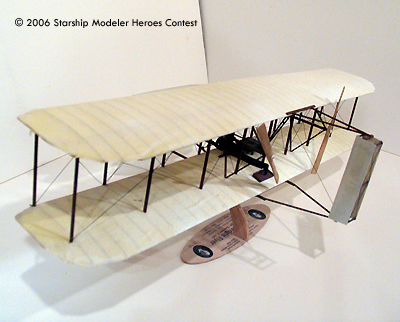
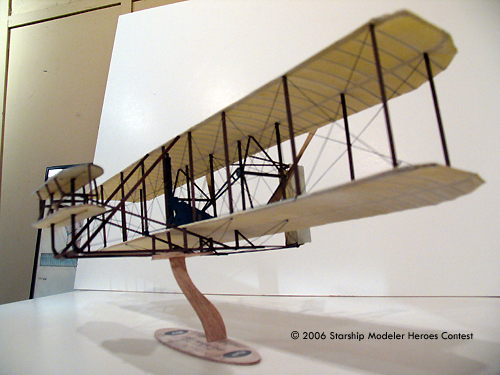
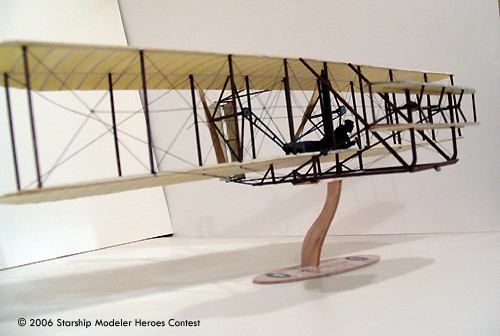
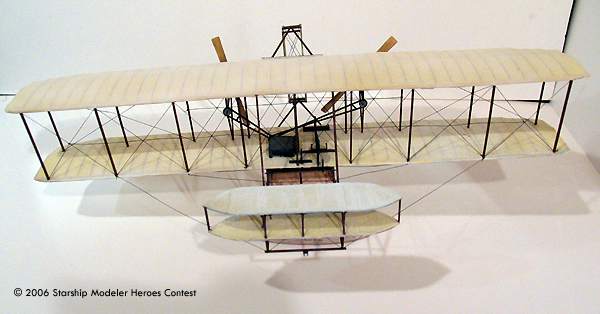
The kit is built from a Guillows all-wood kit in 1:20 scale. The
wings are covered in stretched fabric, airbrushed to appear as linen.
A visit to the EAA Flight museum in Oshkosh provided further details
from a replica of the Flyer, that were handy in duplicating the rigging.
Arguably the first men to break the surly bonds of gravity, the
Wright Brothers set mankinds’ first tentative steps on the path that
has led to the Moon and to the imaginative scale modeling that
populates this web site. Heroes, indeed.
Image: Left/front
Image: Right/front
Image: Beauty
![[Heroes banner by Allison Cottreau]](HeroesBanner2.jpg)