![[Starship Modeler's fifth on-line modeling contest: the future that should have been]](2001_banner.gif)
Once Upon a Time in the Future .... |
VISIT OUR SPONSORS
|
|
|
Scale: None stated A half century ago the year 2001 seemed very far away. As a youngster I got ‘hooked’ on Science Fiction very early. I never read the ‘classics’ kids are supposed to read - I read Heinlein rather then Frank Baum, I read Clarke and Norton rather then ‘Alice’. And I watched Disney - not so much for the Duck stories or Mouse adventures, but for the Science Fiction. And the Science. WAY back then, the idea of men going into space was a dream. There were no satellite dishes on our homes, there were barely T.V. antennas. There were no satellites, period, barring the Moon itself. There were no space shuttles, or ICBMs, or commercial lifting bodies. We had - at best - V2s left over from WW II, and Aerobee Hi sounding rockets. And we had dreams. Aided and abetted by people like Werner Von Braun, Willy Ley, and other scientists and writers. And when Disney and Von Braun worked together to produce ‘Man Into Space’ - we had wonders. For the first time, the general public was introduced to the ideas of space travel, from sounding rockets, to early satellites, then on to communication satellites (thanks, Mr. Clarke) and finally, manned space exploration. |
|
|
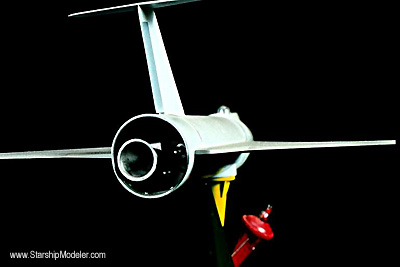
I was permanently affected by the launching of the first manned space shuttle - in the 1950's on T.V. with the help of Disney animators. The Von Braun manned orbital rocket with it's many engines blazing fire, and it's winged top stage perched on top of this giant conical 'thing' like an angle on the top of a very unconventional Christmas tree. Then Strombeck-Becker began releasing models from Men into Space. I got the cargo rocket (transparent with colored paper inserts showing the internal structure) and the 4 stage manned ship and the Lunar Orbiter/Recovery vehicle. But they never made a model of that lovely winged top stage, or at least no model over 2 inches long. And after a while, those models vanished from the store shelves and became very expensive collectors items. I wasn't about to dismantle my one and only Retriever vehicle.... Then Glencoe began re-releasing the 'classics'. And I had another chance at that winged wonder. I bought several of the Lunar Recovery Vehicles and began building. ABOUT THE MODEL This model is pretty much the straight, original Disney manifestation of the Von Braun return stage glider. The wings are slightly smaller than the original specs called for. Experience has shown that smaller stronger wings that don't tear off under the tremendous stresses of re-entry are a lot better than large gliding wings that do - even if the larger wings make for slower landing speeds and better handling. (Experience has also shown that T tails like this might not be a great idea in the turbulence generated by the shock of re-entering the Earth's atmosphere, but it looks so neat....) I used the body of the Lunar Retriever, lengthened with one of the external fuel tanks, to approximate the proportions of the original design. I modified the engine area with more 'detail' so it didn't look so bare. The wings are simple triangles of styrene sheet connected by a wide strip that goes through the middle of the ship for strength - all cut from one sheet of .030 stock. The T tail is more sheet stock, trimmed and painted. No secrets here. The windows ahead of the antenna mount ring were used stock as were the domes and cockpit 'glass'. Control surfaces are delineated with a darker gray to show a more ablation resistant material. The 'bottle suits' are nice, but the 'arms' are not rendered at all well. Instead of the many robotic arms or the original design, each with a different tool on the end and spaced around the perimeter of the suit, they molded in 4 blank gussets. I used fine styrene rod and some very thin sheet stock to mock up several arms for each suit, painted the suits brightly, and used rub-on lettering for their numbers. Image: Rear view Image: Bottle suits Image: Top view |
||



![[Millenia Models International]](mmi.gif)




This page was last updated 31 July 2001