![[Starship Modeler's sixth on-line modeling contest: Battlewagons!]](battlewagon_contest.jpg)
Mystic-class Dreadnought USS Mystic Fire, NCC-2968 |
||
|
|
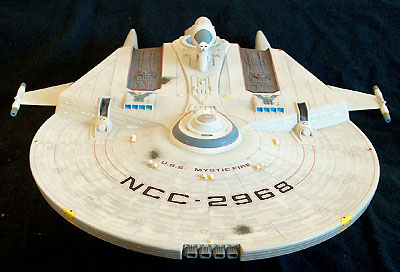
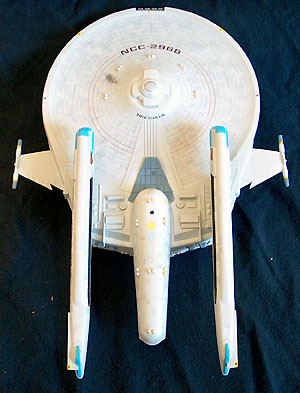
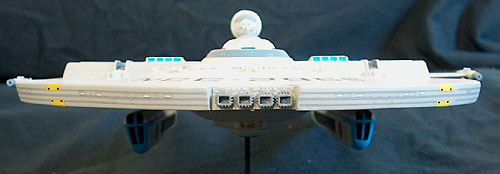
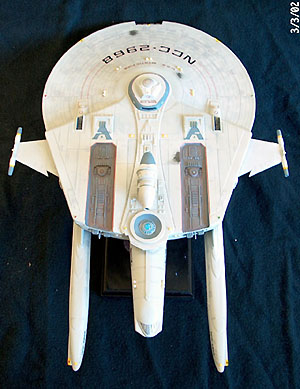
By April Welles Scale: 1/537Mystic-class Dreadnought USS Mystic Fire, NCC-2968 This is the USS Mystic Fire, NCC-2968. She was designed in 2290 by a felinoid race known as the Falosians, and uses many of their philosophies in her design. Her primary appearance is similar to a cat about to pounce. She was created due to an increase in hostile activity along the Klingon Neutral Zone. At the time of the original design and construction phase, it was deemed a resourceful idea to use a design that was already familiar, and overall easy to modify to a degree. With that in mind, she was designed using a similar hull structure as the Miranda-class incorporating a stealth package with hidden strength. The Falosians believe that not all powerful ships need to be extremely large. This design also happens to fool most threats into believing that she isn't as powerful as she truly is. A primary difference from the Miranda-class design is the inclusion of a secondary hull. A less obvious difference is that the warp nacelles are brought in closer, and more underneath the hull for better protection, and a more slender ship signature. |
|
|
All four ships of her class (USS Mystic (of course), the Mystic Ice, and the Mystic Spirit) use a similar design philosophy with regards to dreadnoughts. The Mystic-class has a secondary hull to incorporate a second warp core. The reason for this seems obvious -to the Falosians anyway. The warp engine in the secondary hull powers the weapons and shields. That's it. When you incorporate an engine that can propel a vessel 120,000 metric tons to a speed approximately 1,730x the speed of light, imagine the power output that could be achieved if it were used primarily towards shields and phasers. And with the logistical proof from the T'Larian Incident of aft-firing torpedoes it just makes sense to incorporate those into its design.
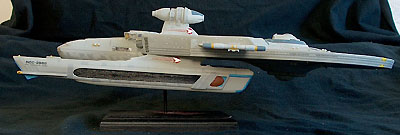
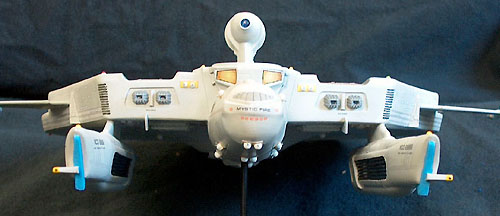
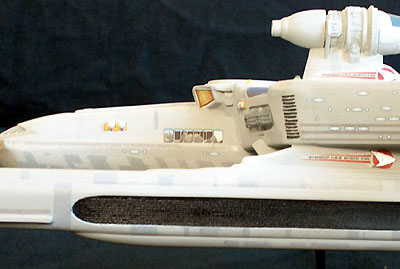
Since Starfleet was not, and is not, allowed to use cloak technology, they use a masking system. In essence, it can make the ship appear on another vessels' sensors as a smaller vessel than it truly is (e.g. a destroyer). Or it can appear as a completely different type of ship altogether (e.g. a ore freighter). Thus a threat vessel would approach the ship far less cautiously than it would otherwise. The primary reason that this system works is because the command section of most vessels do not have windows. They must rely upon what their sensors say is 'out there'. The pictures of the Mystic Fire shown here are as she has just arrived from a Dominion conflict. The battle scars shown on her hull are where Jem'Hadar attack ships flew into her in an effort to destroy her. Model Construction I decided to build this ship because I had some thoughts as to why dreadnoughts always had to be huge, as well as with 3-4 nacelles. I decided that since I had a number Reliant models laying around, that I would build something from one of them. The Sensor Mask is my own idea. I had an old B-wing fighter cockpit laying about and had spent a number of years trying to decide what to do with it. I eventually created the Sensor Mask idea, removed the rollbar, and replaced it with the B-wing part. I had come up with an idea of creating a torpedo boat using the Miranda-class models by adding a large number of launchers to set locations on the model. The aft ones cover ½ of the location ideas that I had. The forward ones came from my spares drawer. I have seen them used on the Akyazi-class model. The problem that I have with that launcher design, is that the launchers are located quite a ways into the saucer. I thought that the designers would have the ship contain more ship space for crews quarters, labs, and other requirements. I shortened the height of the engine pylons by about half, and placed them more underneath the hull in order to protect them from above. The phaser cannons were placed horizontally on pylons to allow them a larger firing arc than the standard Reliant ones. Those couldn't fire beneath the ship. This design allows for that. Plus the cannons are scratch built since they are supposed to be more powerful, they have to be designed slightly differently. There is also a phaser bank located on the outside edge of the cannons to provide full 720 degree phaser cover. I cut out the main deflectors from underneath the ship and placed them above and at the proper width so that they don't 'damage' the ship. And replaced the lower area with greeblies. The secondary hull is the secondary hull of the 18" TOS Enterprise glued sideways with the lower section glued on top of that, while the Excelsior aft-shuttlebay is it's own. It's actually quite close to 1/537 scale already. Underneath the shuttlebay is one of the little gumball machine ball containers minus the lid, cut in half and blended in with the rest of the hull. The forward part of the 2nd hull is a small round measuring scoop, found from the kitchen, also cut in half and blended into the model. I used the hull raisers from Federation Models on the kit to get it to the proper height. It was a shame to cover up the shuttlebay detail with the Torpedo Launchers, but... it needed to be done. Besides I like the effect. In terms of the hull panels, I used my usual decals, then oversprayed them with MM Light Gray from my airbrush. Plus lightened MM Intermediate Blue around the bridge and the upper deflectors. I also used Testors Flat Enamel Sky Blue for the bussard collectors, and the final stage intercoolers, to add a slight amount of color. I then used special ordered Miranda-class decals from J T Graphics including the lit windows. The battle damage was a combination of dry brushed MM Jet Exhaust, Flat Black, and Rust, to give the image of char damage as opposed to real damage. These shields are supposed to be extremely powerful, so not much should get through except for carbon scoring, at best. The phasers were the heads of pins. I don't really like using those, but I didn't have any of the phaser bumps from DLM. I had to make do with what I had. This was not a bad project for experimentation. Who knows maybe I'll do another one later, with more details. "It is easier to try, than to prove it can't be done." -Justin Hayward- Image: Rear view Image: Botanical gardens Image: Bottom Image: Head-on Image: Overhead |
||
This page was last updated 18 March 2002